The Journey
The direct train from Amsterdam Centraal to Berlin Hbf took 6 hours and 25 minutes. Here it is arriving in Amsterdam Centraal before departure. I boarded and went to my allocated seat, where I found out that I had a whole compartment to myself. I proceeded to settle in and make myself comfortable for the long trip ahead.
The journey was largely over flat agricultural land and was quite boring at times. I was surprised at how rural and forested the land was, coming from the largely urban Netherlands.
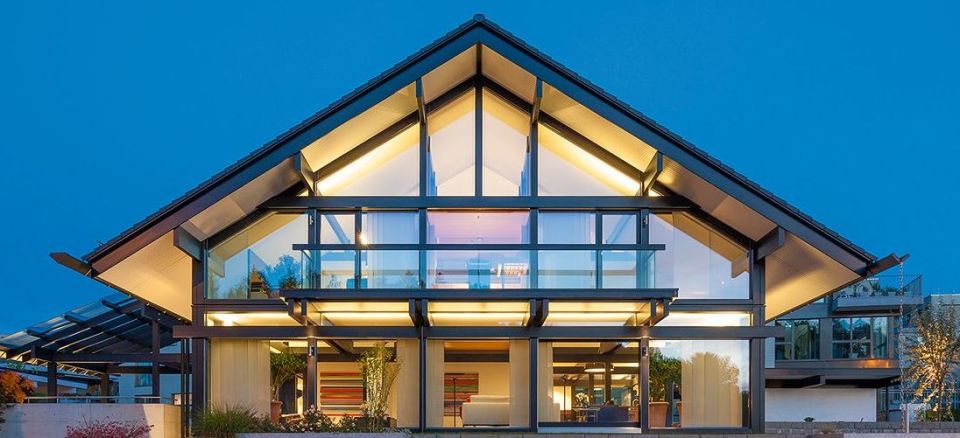
I spotted some distinctive Huf houses dotted here and there, these are a particular type of modular kit houses that made an impression on me when they featured on a housing design show on Channel 4, maybe 20 years ago. We even went to visit one of their showhouses once when we were in Co. Waterford on holiday. I wasn't ever quick enough to grab a photo of one from the train, so here is a photo of one from their website instead.
I was glad to have plenty to read with me to pass the time, though really fast wifi was also available for the whole trip. The train and toilet were very clean. Except for 90 minutes of the journey, I continued to have the whole compartment to myself.
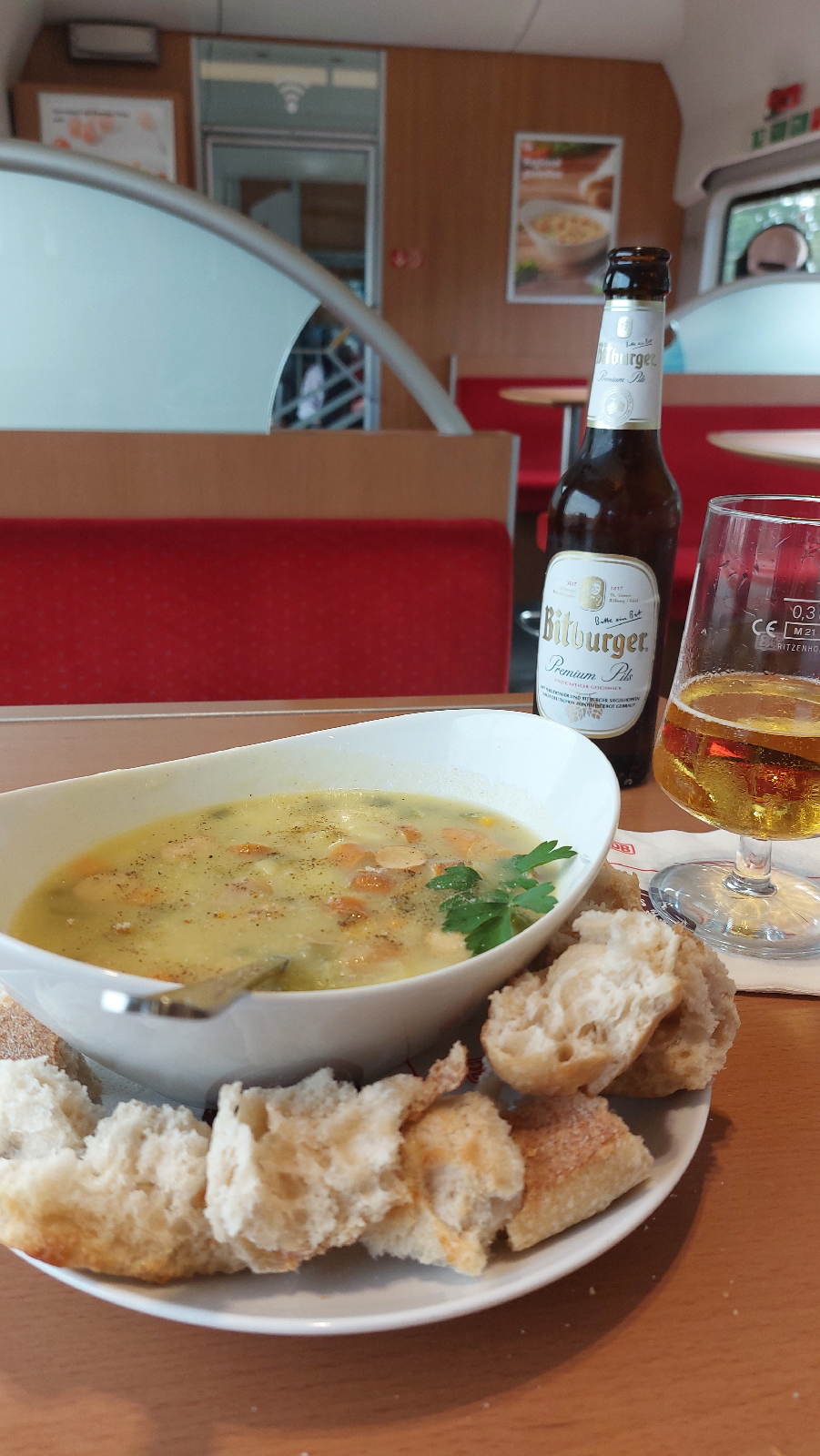
I had my two sandwiches with me from Michel and Ingrid's house, which I ate for lunch, but then I also decided to have my evening meal in the dining car before arrival.
I chose Kartoffeleintopf mit Geflügelwienern und Bio Brötchen, a hearty German stew with smoked chicken sausage, potato, carrots, onions, peas, celery and something else green! It was served with an organic bread roll. This was swallowed down with a Bitburger Pils, chosen for me by the restaurant car manager, when I couldn't make up my mind. Yum!
When I arrived in Berlin it was dark and rather than struggle with navigating a U-Bahn / S-Bahn / M4 route suggested by the BVG travel app, I checked the price of an Uber. As it was less than €7, I opted for the taxi as the rucksack was feeling heavy. This was a good decision!
The Accommodation
The small HomeExchange flat was located in Prenzlauer Berg, an area that once formed part of the former East Berlin. It is now a hip neighborhood with many cafes, restaurants and galleries.
I picked up the keys from Jeanne and Suzon's neighbour Michael as planned. On opening the door, I was greeted by two very loud and very hungry cats - Léon and Simba. Here they are AFTER I had fed them !!
My home for the next three days was on the first floor, with a view of a calm courtyard.
The apartment was pretty much as I expected from the HomeExchange site.
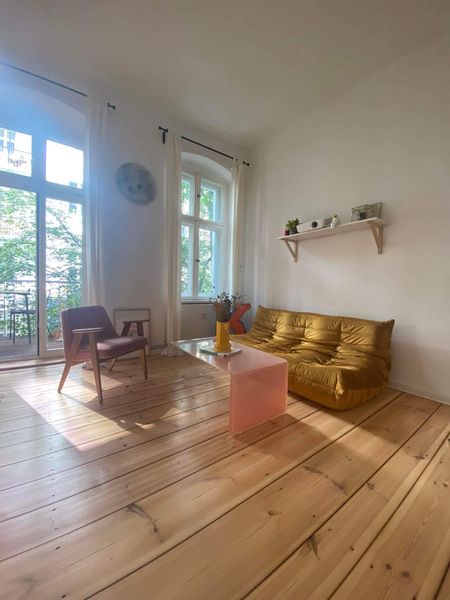
It had a nice
balcony where I was able to enjoy a morning coffee. The
decoration style was arty and minimalistic.
Exploring Berlin, Day One
It was only a few weeks before my trip that I realised that my visit to Berlin would fall during the Unification Day holidays. Everything would be closed on Tuesday for the official holiday, and I was told that most people were planning on taking Monday off as well to make a long weekend of it.
So I didn't know what to expect as I headed out on my first morning. The plan was not to do any cooking or food preparation at all, and to enjoy different breakfast, brunch and dinner options. As I strolled along the streets of Prenzlauer Berg however, all I could see in the streets were closed doors and shuttered windows. I eventually came across a supermarket which was open, so I got enough breakfast stuff for three days. Prices appeared a lot cheaper than at home with this lot costing just €14.
After breakfast I activated my 48-hour Berlin travel card, which seemed relatively good value at €20, this would cover all my travel needs until departure on Wednesday, and so I headed out looking for the nearest tram.
The two museums I wanted to visit were the
Stasi Museum and the
DDR Museum to give me some understanding of life in the former East Germany. I started with the
DDR Museum, as I couldn't find out definitively if the other one was closed or not. This is a small private museum which is very interactive and hands-on, you are encouraged to open cupboard doors and drawers and handle some items. In fact it didn't feel like a museum at all, rather a large showroom depicting life in the DDR through everyday household objects and consumer goods.
The current exhibition was called GDR Daily Life in 200 Objects. What I found interesting was that a lot of it looked very familiar! Even the wallpaper looked similar to something in our home in the 1970s! The following photos are a selection from the exhibition.
Here is a typical family office desk - they weren't called home offices in those days!
Next there was an electric hob, saucepans and casseroles in floral patterns or the ubiquitous orange colour of the 1970s, plus a typical drip-type coffee maker.
Thirdly there was a state of the art media storage unit, with an early colour tv showing tv programmes from the era.
I was delighted to see an East German Trabant, and even more so when you
were allowed to sit behind the steering wheel. You had to wait 16 years
if you wanted to buy a new one!
This one is the Trabant 601. I couldn't believe it when the numbers lined up - it was 26 horsepower, had a 26 litre petrol
tank, and it was in production for 26 years (relatively unchanged) from
1964 to 1990.
As I sat close by having a light lunch from a streetfood vendor, I finally found out that the Stasi Museum would be closed for both of my days in the city, which was disappointing.
The Walking Tour
In the afternoon it was time for my 3-hour walking tour, booked with the GuruWalk app, called Berlin Under The Swastika. The tour explored the dramatic shift in the history of the city under the Nazis and traced the steps of the rise of the Third Reich until it came to an end. It also looked at Berlin as being the birthplace of powerful forms of resistance - big and small.
Tina our guide, a self-confessed history geek from Melbourne was an amazing font of knowledge. The most interesting part of the tour was the visit to the former Jewish quarter where Tina explained about the thriving Jewish life here before 1933, and how it was soon lost.
There are over 11,000 'stumbling stones' all over the footpaths of Berlin commemorating Jews who fell / stumbled / were killed / disappeared. Throughout Europe there are over 100,000 stones.
These five stones remember a family of five who perished in a house nearby, including a child.
This is a memorial to the Jewish Women's Resistance Movement.
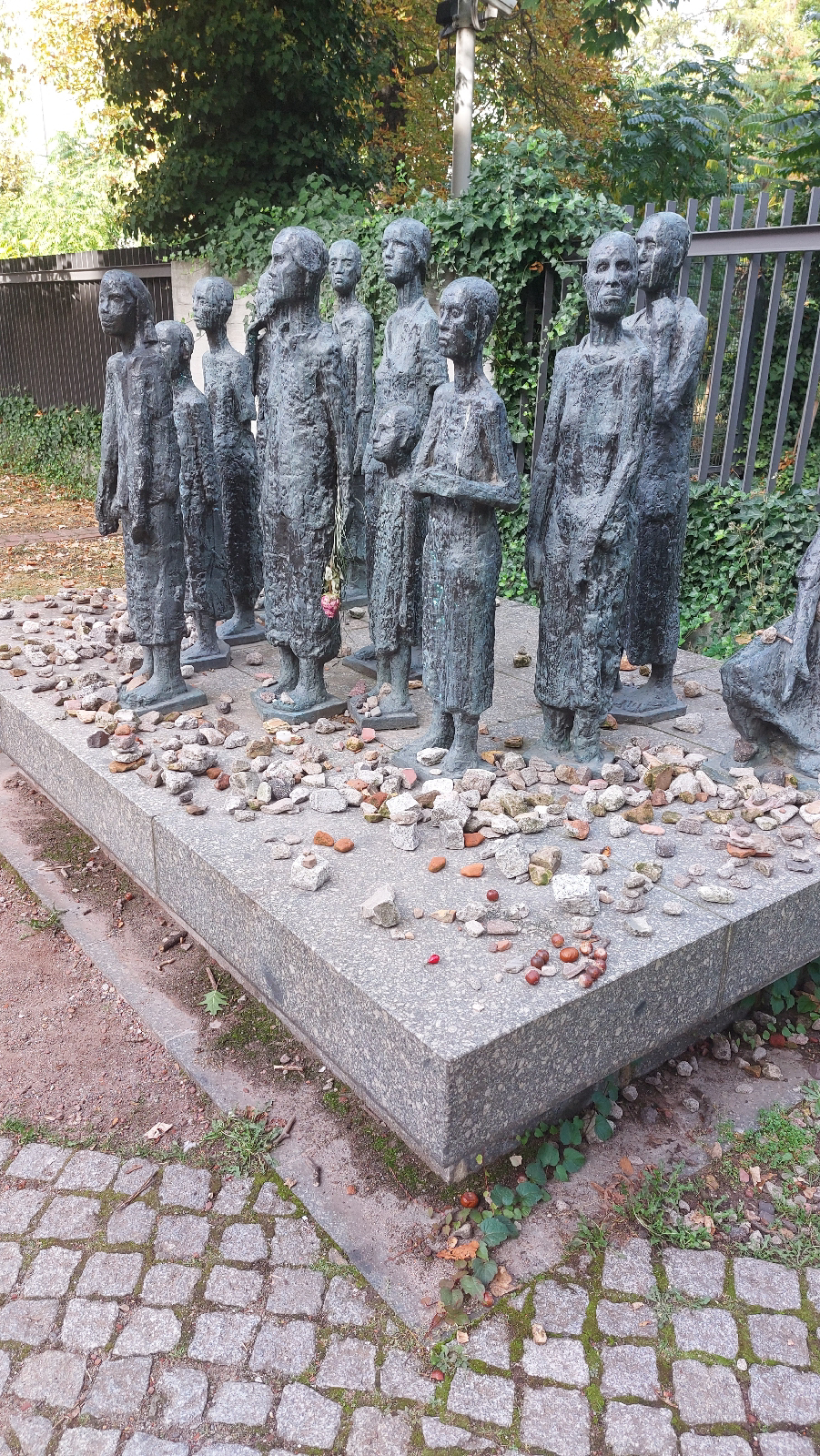
This moving sculpture commemorates the 55,000 Jews who were deported from this so-called 'Jewish
Care Home' to concentration camps.
The photo below was taken in the first Jewish cemetery in Berlin to be desecrated by the Nazis, where there was only a handful of Jewish graves were not destroyed. The stones on top of the gravestone are regarded as the equivalent of wreaths, and as a more lasting tribute to the dead than flowers.
Other parts of the tour covered the former ministry district and Reichstag, the propaganda machine, the glorification of the Fuhrer, the memorials dedicated to groups victimised by the Nazis - including the Roma and homosexuals. You would need a full blog post to cover properly everything that was shown to us, but the photos above from the Jewish section of the tour give a flavour of the full tour.
All in all, Tina covered a huge amount of information in her 3.5 hour tour, and we traversed large sections of Berlin using public transport. This was a much longer walking tour than any previous tour that I had done and my back was starting to feel sore.
Thankfully the evening was more relaxing. I had arranged to meet my cousin Malachy and his Australian girlfriend Sarah in a Biergarten near where I was staying. They have both been teaching here in Berlin for the past few years, so they know the city well. It was great to get their impressions on life in Berlin and some back-up recommendations for the next day, if museums and attractions happened to be closed for Unification Day.
Day 2 German Unification Day
My second GuruWalk walking tour started at 10am, the tour guide today was Will from England, another self-confessed history nerd whose tour was called From Marx to the Wall, the Berlin Communist & Socialist Tour.
We walked around mostly the former East Berlin seeing where historically significant events took place.
There was a lot of detail to absorb and plenty of different interesting characters from Marx and Engels ...
... to the revolution led by Rosa Luxembourg and Liebknecht ...
Then it was on to buildings and notable locations from the Cold War era, which unsurprisingly took up most of the time remaining. So, for example, below is the former East German State Council building (now the International ESMT School of Business and Management).
The lobby contains some striking East German stained glass.
Here is the new Humboldt Forum, a €2 billion reconstruction or replica of the former Palace of the German Monarchy, which was largely demolished by the East German state. It is now home to an arts and cultural centre. The craftsmanship of the building is outstanding, and the building as a whole looks like an original building that has recently been cleaned up.
We could hear the Unification Day official ceremony as we passed behind the stage to get the U- Bahn for the next stage of the tour.
The new Humboldt U-Bahn station is impressive, the design by Max Dudler was inspired by a stage design for the opera The Magic Flute and features a starry sky on a dark blue barrel vault with points of light over the tracks.
We viewed some stand-out apartment buildings on what was the main street in East Berlin.
East Germany decided to build these 'Palaces for the People' to celebrate Stalin's 70th birthday. The street was called Stalin Allee and it later became Karl Marx street. This intersection is an important landmark as the People's Revolution of 1953 started from here.
We then went on to see a memorial plaque to commemorate one of the many small and large concentration camps that were set up all over Berlin. This one was termed 'The Murder Cellar'.
In the recent past, the building was occupied by clothing brand Thor, till anti-fascist protests in 2009 forced them out and their clothing stock was burned.
The tour ended up at the East Side Gallery, an aptly-named section of the Berlin Wall which has become an open air gallery of images, mostly celebrating the rise of leftwing movements in recent years.
I loved all the outdoor art and the stylish graffiti.
It was a thoroughly informative and interesting tour. Will was an excellent guide, providing an enjoyable and engaging presentation of a complex topic. He pointed out details which I would never have seen or even noticed without his guidance.
When the tour finished, he recommended that we should stroll down to the Kreuzberg area as far as the canal, as there were countless food trucks. Here I bought a range of German streetfood and had a picnic by the water, before heading back to East Side Gallery to pick up an open-top bus tour, as I knew that it would be impossible to see the whole city in the short time that I had left without one.
Open-Top Bus Tour
The bus tour did cover some of the same ground that I had already covered, I didn't really mind as it felt so good to be just sitting back and listening after 4.5 hours of walking! I will only include one or two of the many photos here that I took from the open top tour ....
The Cube building is an intelligent building, it has 8000 AI sensors that learn from the workers who work there.
This beautiful building is the residence of the German President.
Finally, the infamous Checkpoint Charlie was surrounded by tourists, but worth seeing nonetheless.
Overall Impression
My overall impression of Berlin is of a lively, hip and interesting city, still changing and still dealing with reunification more than two decades on, where the differences between East and West Berlin are still visible if you look, though not always obvious at first sight.
I also had no idea that the city was so spread out; both tour guides mentioned that it had an area nine times the size of Paris, and a population of 3.5 million. I hadn't a hope of seeing everything I wanted to in two days, but I felt that I now knew it at least on a surface level, and could pinpoint some of the city neighbourhoods on a map. There is definitely enough to see and do here to merit a return trip - and a longer one at that, a time when hopefully the Stasi Museum will not be closed!
Next day, I had to be up bright and early for my morning departure by train to Prague, so it was an early night for me. All this walking was ensuring that I slept soundly again.







Comments
Post a Comment