32. Kaunas, Lithuania

The Journey


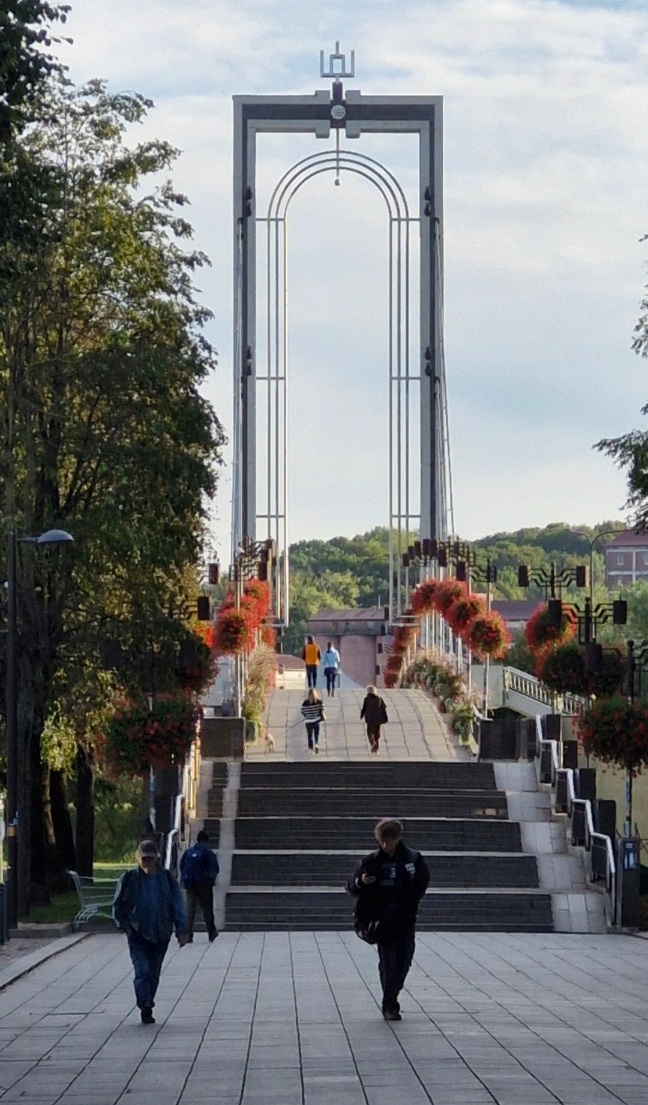
Pedestrian Bridge over the Nemunas River
Kaunas has a current population of nearly 300,000, so it is roughly the same size as Belfast. It acted as a “temporary capital” for Lithuania during the interwar period. Vilnius, was still “the declared capital” but it was part of Poland from 1920 until 1939. The building below is called Commandant Palace, an administrative building for the city.

Due to Kaunas being the temporary capital for these two decades, over 12,000 new buildings were constructed, many in the Art Deco style or the Modernist style which were both popular at the time. This rich architectural heritage has been recognised by UNESCO and Kaunas has been given the title UNESCO City of Design. This was my main reason for wanting to visit the city, as I have been interested in Art Deco and Modernism for the past 25 years.

I could clearly see Art Deco buildings on every street as I continued my walk.

Some were complerely restored, some were in the process of restoration, as in the photo below.

There was a definite chill in the autumnal air as I walked from the hotel towards the city centre. I passed through several covered markets and for the first time on this trip I got sight of poverty. There were maybe a dozen older women sitting on the pavements, some selling a few vegetables, some selling flowers, others household items.

I spotted an interesting tourist attraction called the Yard Gallery (above) on the map, so I went in its direction.

It was essentially a back yard between several apartment blocks. The plaque below explains its history.

It was a riot of colour and creativity.


I headed in the direction of the tourist office as I wanted to see if there were any maps highlighting the Art Deco and Modernist buildings that Kaunas is famous for. It was on the main pedestrianised street which must be 2km in length.


The woman on the desk was so helpful, giving me two detailed maps covering every significant Art Deco and Modernist building in the city.
Not only that but when she heard I had come from Ireland, she gave me a gift of a book of black and white photos of the city's architecture (below), normally given to visiting VIPs! That certainly made my day!

Many of the buildings constructed during the interwar period were private residences for wealthy individuals, such as the two wonderful examples below.


The vast majority of new buildings however, were apartment buildings like the following four examples, all built in different styles but each one very clearly Art Deco. .


There was a significant number of public service and government buildings, built to meet the needs of "the temporary capital", such as the following three - all still in use. …


Some were schools, and these all seem to be still in operation as well. Here is just one of them.

Some were churches. This one is the magnificent Basilica of the Resurrection, built on a hill and visible from all over the city. It is the largest church in the Baltics.

It has had a varied and interesting past. Building work started in 1934. Then in 1940, during the German occupation, it was converted into a paper warehouse.

In 1952, the Soviets turned it into a factory for making radio receivers.

The interior is minimalist painted white concrete.

There are magnificent stained glass windows which are currently being refurbished one by one, and a beautiful modern set of the Stations of the Cross. There is a great article online about the church for anyone interested at www.komoot.com/highlight/927274 This is where I found out afterwards that there is a viewing platform on the roof with apparently superb views of the city and surrounding countryside. Unfortunately this was not indicated on any sign in English inside the church.
Most Lithuanians are Catholic and there are 23 Catholic churches in the city. Two other important churches (older than Art Deco) are below.

This one, St. Michael the Archangel Church, is in the city centre at the intersection of four streets. It was built in 1895 in a "neo-Byzantine" style by Tsar Alexander III of Russia.
This one is the Basilica-Cathedral of Saints Peter and Paul. It has a rather plain exterior ...

... but the interior is very lavish and ornate.

Also in the Old Town you will come across the Church of St. Francis Xavier, which has an almost Spanish appearance.

Getting back to the Art Deco / Modernist heritage, here is an interesting small funicular, which was built in the Modernist style in 1931, with its original interiors still intact. I couldn't resist taking the ride to the top of the hill, it only cost €1.


At the top there was a very attractive bar with a sunny outdoor garden space. The setting was glorious and I was tempted to sit down in the afternoon sun and enjoy a beer. This gave me the chance to pore over the detail in the maps provided by the tourist office.

By mid-afternoon, I had found another cool bar serving food. I ordered a truly East-West fusion dish of Mexican Quesadillas served with paprika wedges and Lithuanian coleslaw! Despite the description, it tasted great. As Lithuania uses the Euro, prices were very transparent … and were also cheap.

I resumed my self-directed walking tour after the food. I realised that it would be impossible to see all 68 Modernist buildings and all 32 Art Deco buildings recommended on my two maps. Kaunas was proving to be much bigger than I anticipated, so I just decided to make my way along one other longish street with several notable buildings. One of these was the Art Deco Museum (photo at top of this blog post). However as it is closed on a Monday I was unable to visit.
Below are a few more buildings that I will not name or explain, they are just shown to give a sense of the huge range of styles within the unique Art Deco and Modernist heritage of the city.


And yes, Kaunas does have an Old Town as well, but not as extensive or as pretty as any of the other cities I visited. Two of the churches (above) are from the Old Town. Here is the main street …

Food and Drink
After a few hours relaxing in the hotel and charging my phone (which was completely flat with over 100 photographs taken during the day), I started to research dinner options. The very helpful tourist information officer from earlier had given me a few suggestions. It was while looking these up that I accidentally came across Baking Mad Hidden Lab, a Breaking Bad themed diner. That was it, the decision was made as Breaking Bad is still my all-time favourite tv series. I couldn't wait to experience its atmosphere.

Fittingly, it is located in a basement, down a dimly-lit flight of steps, with a “warning” at the bottom before stepping into the "lab".

Everything on the menu nods towards some aspect of the series, and fans of the programme will recognise and smile at many of the descriptions.

To add to the atmosphere, episodes from the show were playing on a loop on a large tv. It was surreal and wonderful at the same time!

The episode being shown was one of the classic ones from S3 where Jesse and Walt are locked in the basement lab and they take it in turn to attack each other with a shovel!

As I already had my Los Pollos Hermanos tee-shirt with me on the trip (pity it was in the washbag tonight!), I simply had to choose a burger bearing the same name from the menu! The food, when it came was really tasty but nothing extra special either.

At the end, on paying the bill, there is an unexpected tongue-in-cheek touch, you get a small zip lock plastic bag containing three wrapped sweets to take with you! As themed restaurants go, this one was really special, but to find it in the middle of Kaunas in Lithuania was, as a character might say on the show, "just goddam weird"!

On the walk back to the hotel, the exteriors of some of the buildings were now lit up, giving them a new dimension. They really looked classy in the white light.

The one above is the Kaunas Cultural Centre.

This one appears to be a public service building …

This is the side of a bar or restaurant.
So that was it, I am so glad I stopped over in Kaunas, it is great to see that its historical heritage is being appreciated and well cared for by the city authorities. It is no surprise that it was chosen as the European Capital of Culture in 2022.
Finally, here is the very modern bus station, taken just as I was about to board my bus to Vilnius. As bus stations go, this mist be one of the coolest ever.

Link to all posts


Comments
Post a Comment